Emergency Plumbing: Burst Pipes and Sewage Backups
What to do first when water is spreading or sewage is coming up, and how to keep pipes from freezing in a cold snap.
A burst pipe, sewage rising through a floor drain or a water heater leaking across the basement floor needs a phone call, not a request form. When you call, say what is happening, where in the house it is, and what you have already shut off.
Until a plumber is there, a few steps limit the damage.
Stopping the Water and Protecting the House
- Shut off the main water valve where the water line enters the house. A round handle turns clockwise until it stops; a lever turns a quarter turn, until it sits across the pipe.
- Turn off the power near the water at the breaker panel, but only if you can reach the panel without standing in water. If water is around outlets, cords or the panel itself, stay out of that area.
- Open the faucets once the main is off: one on the lowest floor to drain what is left in the pipes, and one upstairs to let air in.
- Never thaw a frozen pipe with an open flame. A torch or a lighter can set fire to the wall around the pipe; a hair dryer, or a space heater kept clear of anything that burns, is the safe way to warm it.
- Move belongings out of the water’s way: rugs, boxes, electronics and anything stored on the basement floor. Photos of the water and the damage taken before cleanup help with an insurance claim.
If You Smell Gas, Leave the House First
A rotten-egg smell near a water heater, the furnace or a gas line is not something to track down from inside. Get everyone out. Do not switch lights or appliances on or off, use a phone indoors, or do anything else that could make a spark. Once you are outside and away from the house, call the gas utility’s emergency line or 911. A plumber is not the first call for a gas smell: the utility or the fire department makes the house safe first.
What to Do First, and What Never to Do
Each kind of emergency has one first move that matters most, and one mistake that makes it worse.
-
Burst or Split Pipe
- Do first
- Close the main shutoff, then open a faucet on the lowest floor to drain the line.
- Never do
- Leave the water on while you look for the break, or tape the split and turn the water back on.
-
Sewage Backing Up
- Do first
- Stop all water use in the house: no flushing, laundry, showers or dishwasher until the line is cleared.
- Never do
- Pour chemical drain cleaner into the backed-up drain, or walk through the water without boots and gloves.
-
Water Heater Leaking
- Do first
- Turn off its breaker, or set a gas heater’s control to off, then close the cold water valve on the pipe above the heater.
- Never do
- Open the drain valve or the relief valve on a hot tank: the water can scald.
-
Toilet Overflowing
- Do first
- Close the shutoff valve behind the toilet, or lift the tank lid and press the flapper down.
- Never do
- Flush again to see whether it clears.
-
Water Coming Through a Ceiling
- Do first
- Close the main, switch off the breaker for the lights in that ceiling, and set out buckets.
- Never do
- Stand under a ceiling that sags with water, or switch on a light fixture in it.
-
Sump Pump Not Running in a Storm
- Do first
- Check the breaker or the outlet it plugs into, and whether the float is stuck against the side of the pit.
- Never do
- Reach into the pit or stand in the water while the pump is plugged in.
Once the water is off and nothing is spreading, fixing the broken pipe or the failed fixture can often wait for a booked visit.
Sewage Backing Up Into the Basement
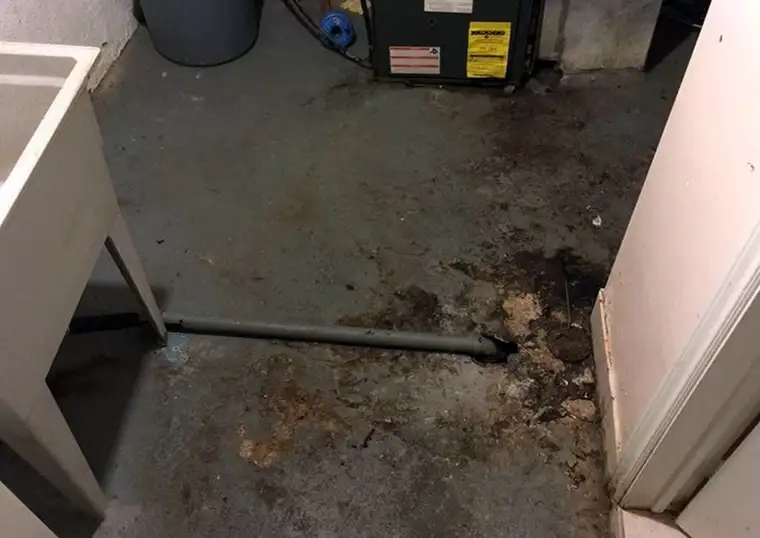
Sewage that comes up through a basement floor drain carries bacteria, so treat the water and everything it touched as contaminated. Keep children and pets away, wear rubber boots and gloves, and keep the area aired out. The water goes back down only when the blockage between that drain and the street is cleared, and anything run upstairs in the meantime ends up on the floor.
After the line is open, the floor, the drain and anything washable that sat in the water need cleaning and disinfecting; soaked carpet, drywall and cardboard usually have to go. A backup that comes back points to the sewer line itself: roots, a sag or a broken section that a camera can find.
Keeping Pipes From Freezing in a Northeast Indiana Cold Snap
The deep freezes that come with northeast Indiana winters find the pipes that run through unheated space or along an outside wall. Before and during a cold snap:
- Outdoor spigots: disconnect the hoses, close each spigot’s shutoff inside the house if it has one, and open the spigot outside so the pipe can drain.
- Crawl space and garage lines: close the crawl space vents for the winter, keep the garage door down, and wrap exposed pipe in foam insulation.
- Exterior walls: let faucets on outside walls run a thin, steady trickle when the temperature drops well below freezing, since moving water is slower to freeze.
- Cabinet doors: open the doors under sinks on outside walls so the room’s warmth reaches the pipes, and keep the house heated even while you are away.
Frozen Pipe or Burst Pipe: How to Tell
The two can look alike at first: a faucet with no water in a cold snap may be either one.
How can I tell a frozen pipe from a burst one?
A frozen pipe shows itself as a faucet with little or no water during a cold snap, sometimes with frost on an exposed stretch of pipe. A burst pipe shows itself as water: a drip, a spray, or a stain spreading across a ceiling or down a wall. A pipe can also be both at once, frozen with a split in it that has not leaked yet.
Should I shut off the main if a pipe is frozen but not leaking?
Not while nothing is leaking: with the faucet on that line left open, you will see the water come back as the pipe thaws. Stay close while it warms, and close the main at the first sign of water anywhere along that pipe.
Why do pipes often start leaking when the weather warms up?
As ice forms in a pipe, it pushes the water ahead of it toward a closed faucet, and that pressure splits the pipe, often some distance from the ice itself. The ice holds the split closed until it melts, so the leak shows up with the thaw.
Is a pipe that thawed without leaking safe to use?
Usually, but look along it once the water flows again, since a hairline split may only seep at first. A pipe that froze once is likely to freeze again in the same place, so that run is worth insulating or rerouting before the next cold snap.