Leak Repair and Repiping
Finding leaks in supply and drain lines, fixing them, and knowing when the pipe around them is due for replacement.
Leaks come from two kinds of pipe. Supply lines carry water under pressure all the time, so a supply leak runs whether anything is turned on or not. Drain lines carry water only when a fixture is used, so a drain leak shows up after a shower, a flush or a load of laundry.
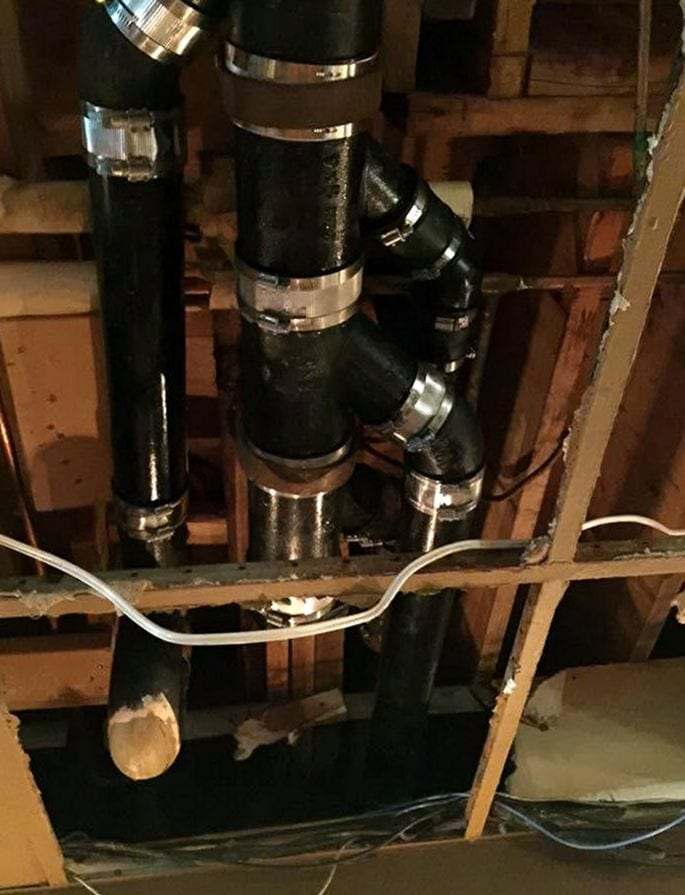
In older houses, many drain leaks come from cast iron: a cracked hub, a section of stack rusted through, a joint that has pulled apart. The damaged length is cut out, and new pipe is joined to the old with no-hub couplings, stainless bands clamped over a rubber sleeve.
Most leaks end with a repair. When the pipe around the leak is worn out as well, replacing it is the better plan; when a job calls for repiping or a new water line, we handle that too.
Clues to a Hidden Water Leak
- A water bill that climbs with no change in how the house uses water.
- Stains on a ceiling, a wall or the floor around a fixture, or paint that bubbles.
- A musty smell in a closet, a vanity cabinet or one corner of the basement.
- The sound of running water when every fixture in the house is off.
- Low pressure at one or more faucets that used to run strong.
The water meter can confirm a leak. Turn off every faucet and every appliance that uses water, note the reading, and check it again after an hour or two. If the reading has moved, or the meter’s small leak indicator is turning, water is going somewhere.
Tracing a Leak to Its Source
Water travels before it shows. A drip from a supply fitting can run along a joist or a pipe and stain the ceiling several feet away, so a stain marks where water collects, not always where it starts.
Leak finding works by narrowing things down: shutting off fixtures one at a time, watching a pressure gauge with the main closed, checking walls and floors with a moisture meter, and running water through one drain at a time to see when a stain darkens. That keeps the opening in a wall or ceiling small and in the right place.
The Main Shutoff and the Wait for a Plumber
Where is the main water shutoff usually found?
In a house with a basement, it is usually where the water line comes through the foundation wall, next to the water meter, often on the side facing the street. In a house without a basement, look in a utility room, near the water heater or in the crawl space where the line enters. There is also a valve in a small box near the street, but that one is usually the water utility’s to operate. Find the main and try it before there is a leak, and tag it so anyone in the house can find it.
What if the main shutoff will not turn or will not close all the way?
Do not force it with a long wrench or a hammer: an old gate valve can snap its stem or break inside, and then it will not close at all. Turn it gently back and forth a little at a time. If it still will not close, call the water utility about shutting the valve at the street, and plan to have the old valve replaced with a quarter-turn ball valve.
What should I do while waiting for a plumber after a leak?
Once the main is off, set the water heater to its vacation or pilot setting, or switch off its breaker, so it is not heating while no water comes in. Keep everyone out from under a ceiling that sags with water, and set a bucket below it. Then start drying what you can reach: empty the cabinet under a leaking sink, leave its doors open and run a fan or a dehumidifier. Leave the wet wall or ceiling itself closed, because the way a stain spreads helps trace the leak.
Copper, Galvanized, PEX and Cast Iron: How Each Fails
| Pipe material | Common in | Typical failure | Repair or repipe leaning |
|---|---|---|---|
| Galvanized steel (supply) | Houses built before about 1960 | Rusts from the inside, so flow drops and threaded joints start to leak | Repipe: once one section fails, the rest is the same age |
| Copper (supply) | Houses from the 1950s on, and many repipes since | Pinhole leaks, often on lines with fast flow or corrosive water, and splits from a freeze | Repair a single leak; repipe when pinholes keep turning up |
| PEX (supply) | Houses built or repiped since about 2000 | Leaks at crimp or clamp fittings, or a nail through the line; less likely than metal to split in a freeze | Repair: the damaged length is cut out and joined with new fittings |
| Cast iron (drain) | Drain and vent stacks in houses built before about 1970 | Cracks, and rust-through along the bottom of horizontal runs; scale narrows the inside | Replace the failed section; replace the run when cracks keep appearing |
| Polybutylene (supply) | Some houses built from the late 1970s to the mid-1990s | Gray plastic pipe that turns brittle and fails at fittings without warning | Repipe: no repair makes the rest of it reliable |
How Much of the Supply Pipe to Replace
Spot Repair
A leaking fitting, valve or short length of pipe is cut out and replaced.
- Right for a single failure on pipe in good condition
- Opens one area of wall or ceiling
- Water off only on that line during the work
Partial Repipe
One run is replaced: the line to a bathroom, the kitchen branch or the main line across the basement.
- Fits when failures cluster in one part of the house
- Pairs well with a remodel that has walls open
- Leaves older pipe elsewhere for later
Whole-House Repipe
Every supply line is replaced, usually with copper or PEX, from the main shutoff to each fixture.
- Fits worn galvanized or polybutylene throughout
- Brings back pressure that corrosion took away
- Means openings in walls and ceilings along each run
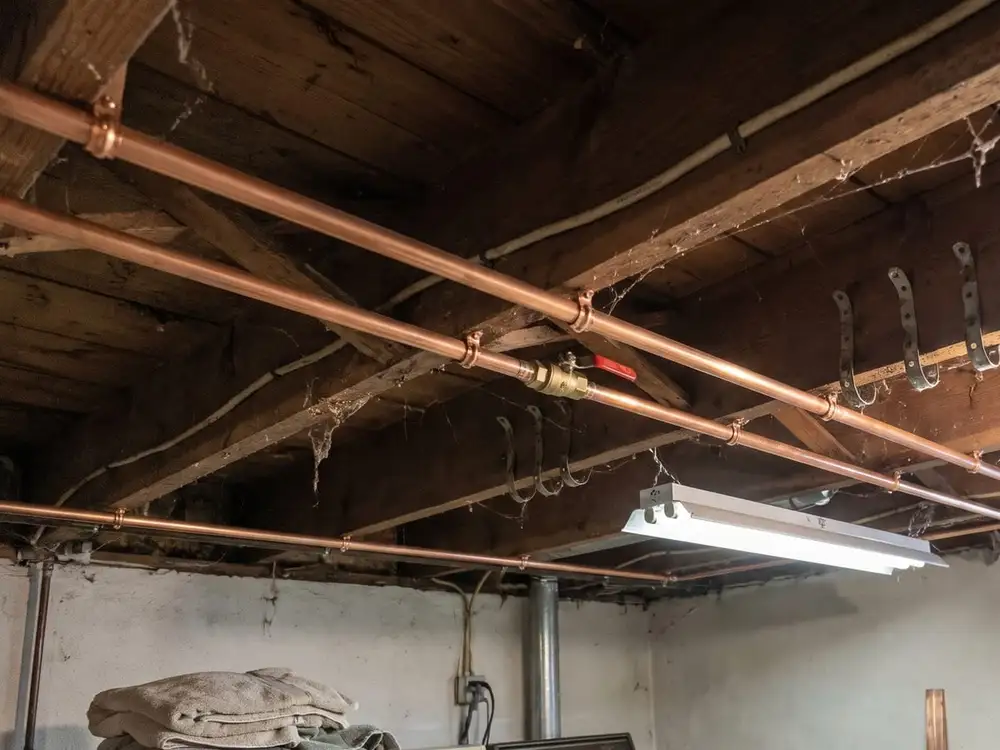
On new supply lines, we hold a pressure test before the wall is closed, so a weak joint shows itself while it can still be reached.
Larger projects are planned in stages so the water stays off for as little time as possible. In a repipe, that usually means running the new lines alongside the old ones and switching fixtures over one section at a time.
Repairing and Rerouting Pipe After a Hard Freeze
Fort Wayne’s deep freezes split pipes on outside walls, in crawl spaces and garages, and behind outdoor spigots. The usual repair replaces the split length; a spigot that split inside the wall is replaced with a frost-proof one long enough to reach heated space.
A pipe that froze once on an outside wall is likely to freeze again in the next cold snap. Moving that run to an inside wall, or insulating and sealing the space around it, is often part of the repair: a short partial repipe that heads off the next split.
A pipe spraying water, or water coming through a ceiling, calls for Emergency Plumbing: shut off the main first.
For a leak you can see, or one the meter says is there, call or send a request.