Water Heater Repair and Replacement
Tank and tankless heaters repaired or replaced, and sized for the household that uses them.
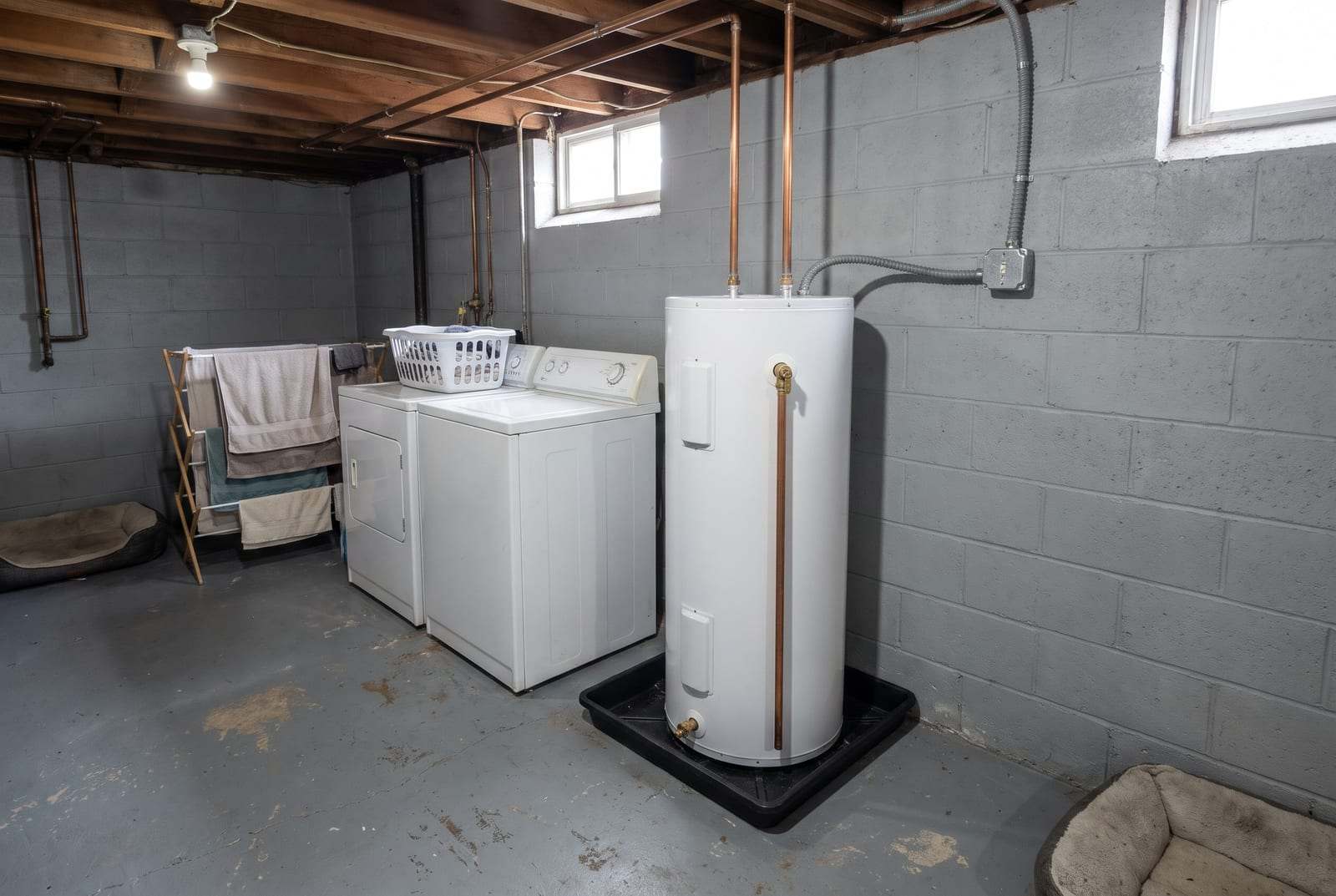
A water heater usually gives warning before it fails: hot water that runs out sooner, a rumble from the tank, a rusty tint at the tap, a damp floor around the base. Many of those are repairs. A heating element, a thermostat, a gas valve, a thermocouple or a relief valve can be replaced without touching the tank.
A heater that leaks from the tank itself is past repair: the steel has rusted through. Replacement is also the time to ask whether the old size still suits the household, and whether a tankless heater makes sense instead. On water heater jobs, we confirm the temperature setting and test the relief valve before the work is done.
When a Water Heater Is Due for Replacement
- Rust-colored hot water. If only the hot side runs rusty, the tank’s anode rod is used up or the tank is rusting inside. Rust from both hot and cold taps points to old galvanized pipe instead.
- Popping or rumbling. Sediment on the bottom of a gas tank traps water that boils as the burner fires; in an electric tank it buries the lower element. A flush can quiet a tank caught early, but years of hardened buildup rarely comes out.
- Water pooling at the base. Check the relief valve’s discharge pipe and the fittings on top first, since those are repairs. Water seeping from the tank itself means replacement.
- Inconsistent temperature. Hot water that comes and goes, or runs out early, can be a failed element, thermostat or dip tube, which are repairs, or a tank that has lost much of its room to sediment.
Age matters too. Tank heaters often last about eight to twelve years, longer on softened water with regular flushing. A tank in that range showing more than one of these signs is usually worth replacing rather than repairing.
Tank Sediment, Flushing and Descaling
Why does hard water shorten a water heater’s life?
Water in northeast Indiana tends to be hard: it carries calcium and magnesium that come out of solution when water is heated. In a tank, those minerals settle on the bottom as sediment. On a gas heater the layer sits between the burner and the water, so the bottom of the tank runs hotter; on an electric heater it buries the lower element. Either way the heater runs longer for the same hot water, and the tank wears out sooner.
How often should a tank water heater be flushed?
Once a year is a common rule where the water is hard, and more often if the tank already pops or rumbles. Flushing drains water through the valve at the bottom of the tank until it runs clear, with the heater turned off first so the water is not scalding. On a heater that has gone years without a flush, the sediment may have hardened and the drain valve may clog or start to drip, so it is best to start while the heater is young.
Does a water softener help a water heater last longer?
Generally, yes. Softened water leaves far less scale in a tank or in a tankless heat exchanger. It can wear out the tank’s anode rod faster, though: that is the metal rod that corrodes so the steel tank does not. On a softened system, the anode is worth checking every few years and replacing when it is mostly gone.
Does hard water affect a tankless water heater?
Yes, often more than a tank. Scale builds up in the heat exchanger’s narrow passages, and the heater loses flow or shows an error code. Where the water is hard, a tankless heater needs its heat exchanger descaled, usually once a year, by pumping a descaling solution through its service valves, and a softener or scale filter ahead of it helps.
Sizing for the Household’s Busiest Hour
A tank is sized by its first-hour rating: the gallons of hot water it can deliver in one busy hour, starting with a full tank. That number is on the tank’s yellow EnergyGuide label, and it matters more than the tank’s size in gallons. A tankless heater is sized by flow: the gallons per minute it can heat at the temperature rise your incoming water needs.
Water Heater Sizing Guide
Set the five choices to match your household, then choose Show My Size Range.
The range counts the showers a household fits into its busiest hour, adds the sinks, dishwasher and washer running alongside them, and allows for cold winter supply water. Treat it as a starting point: the space, the venting and the gas or electric supply settle the final choice.
Winter Supply Water and Recovery Rate
In a Fort Wayne winter, the water entering the house can drop into the 40s Fahrenheit, far colder than in late summer. The heater has to raise it further to reach the same temperature, so a tank recovers more slowly and a tankless unit puts out fewer gallons per minute. A smaller tankless heater that keeps up with two showers in September may manage only one in January, which is why a heater is best sized for winter water.
Heater Types by Fuel, Space and Venting
| Type | Fuel options | Space and venting needs | Best fit |
|---|---|---|---|
| Gas tank, chimney vented | Natural gas or propane | Floor space with clearance around it; a vent into a chimney or metal flue, and air for the burner | Basements with a working flue |
| Power-vent gas tank | Natural gas or propane | A fan pushes exhaust through a plastic vent pipe in a side wall; needs an outlet nearby | Houses with no usable chimney flue |
| Electric tank | Electricity, on a 240-volt circuit | Floor space only; no vent | Houses without gas, or spots where a vent cannot run |
| Heat pump tank | Electricity | A large room of air around it and a drain for condensate; it cools the space it sits in | Roomy basements that stay well above freezing |
| Gas tankless | Natural gas or propane | Mounts on a wall; needs its own vent and often a larger gas line | Back-to-back showers and little floor space |
| Electric tankless | Electricity | Mounts on a wall; needs several heavy circuits and often a larger electrical service | One sink or one bathroom rather than a whole house |
Replacing a water heater often needs a permit and an inspection, and a gas heater gets the closest look: the vent’s size, slope and connection, the gas line and the relief valve’s discharge pipe. Permits and inspections are part of How We Work.
A tank leaking from its body, or a heater that has stopped making hot water, is worth a call. A tank that is getting loud or slow to recover can go in a request.